Choosing a construction mask is not a matter of picking the thickest material on the shelf. The right choice depends on the hazard, the task, and how long the mask must be worn. Cutting concrete can create fine silica dust; sanding wood produces larger particles, while paint spraying may involve hazardous vapors. A disposable filtering facepiece does not protect against every gas or vapor. Check the product’s stated protection and relevant certification before comparing prices.
John Howard, former director of the U.S. National Institute for Occupational Safety and Health (NIOSH), is an occupational health physician whose work highlights the importance of protecting workers from job-related hazards. A practical takeaway from that approach is simple: match protection to the exposure, not just the job title. For anyone researching how to choose the right mask for construction, that means identifying the specific dust, mist, or vapor first. Then check fit, comfort, and compatibility with safety glasses, hard hats, and other equipment.
Fit matters. A mask that leaks around the nose may offer far less protection than expected. Facial hair can also interfere with a tight seal. For a concrete-cutting task, ask whether a certified particulate respirator is suitable for the exposure and whether workplace procedures require fit testing. Product labels and supplier claims deserve a careful look. China-based manufacturers may offer many options, but origin alone does not prove quality. Verify model details, test documentation, and intended use. One limitation remains: no mask can compensate for poor ventilation or an unclear hazard assessment.
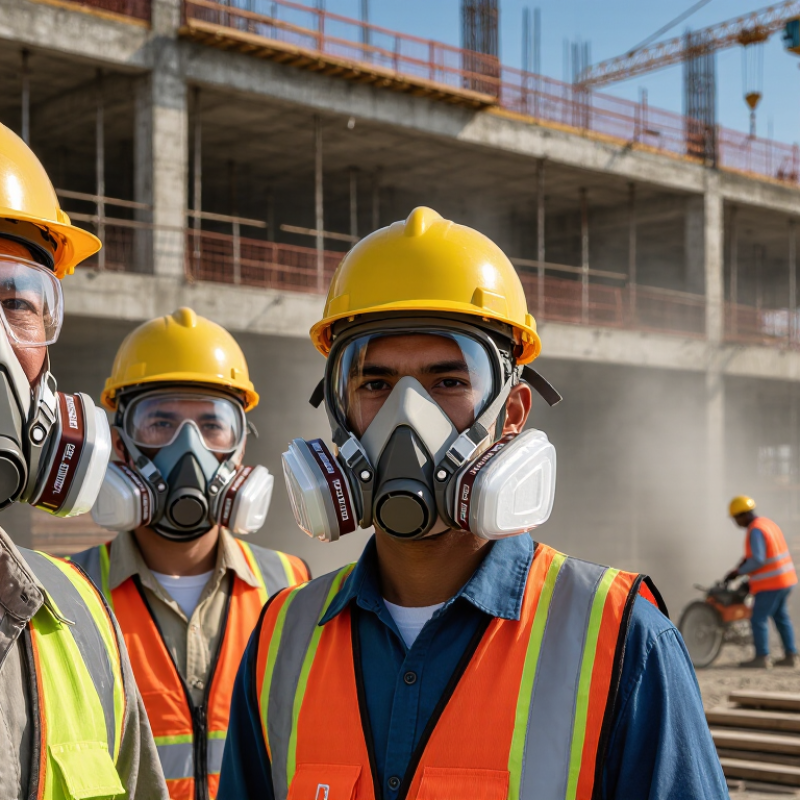
Start with the hazard, not the mask catalog. Cutting concrete creates respirable crystalline silica. OSHA estimates that about 2.3 million U.S. workers face silica exposure, including nearly 2 million construction workers. Its standard sets an exposure limit of 50 micrograms per cubic meter over eight hours (OSHA, 29 CFR 1926.1153). Dusty demolition, welding fumes, solvent vapors, and biological particles require different protection. A particulate respirator cannot safely remove organic vapors. That mistake is common.
Match the selected respirator to the measured risk and work duration. For silica-producing tasks, choose a certified particulate respirator with suitable filtration, then control dust with wet cutting or local extraction. High concentrations may require a powered or supplied-air system. Check the product’s test reports, certification scope, filtration class, and manufacturing traceability when sourcing from China. A certificate alone proves little if it does not match the destination’s requirements.
Fit matters more than appearance. The U.S. NIOSH respiratory protection guidance requires medical evaluation, fit testing, and a written respiratory program. Facial hair, glasses, sweat, and a loose nose clip can break the seal. Workers should perform a seal check every time. I would not claim one mask fits every crew. It does not. A practical trial on the actual jobsite can reveal pressure points, fogging, and breathing resistance before bulk purchasing. The ILO estimated 2.93 million work-related deaths globally in 2019, showing why hazard assessment cannot be treated as paperwork (ILO, 2023).
Choosing the right construction mask starts with the hazard, not the product photo. Dust from cutting concrete needs particulate filtration, while solvent vapors require a different, certified cartridge system. Disposable filtering facepiece respirators suit short, dusty tasks. Reusable half-mask respirators may seal better, but their filters need scheduled replacement. Loose surgical-style masks are not substitutes for respirators. Fit matters more than appearance.
China-made masks may carry the KN95 marking under GB 2626. N95 follows requirements set by NIOSH, while FFP2 follows EN 149. These classes have similar purposes, but their testing authorities and documentation differ. They should not be treated as automatically interchangeable. Check the standard number, approval information, filtration test, breathing resistance, and production batch. Do not trust filtration percentage alone. A 95 percent claim can hide poor fit, missing records, or an unsuitable test method.
For Chinese suppliers, request recent third-party reports and verify the issuing laboratory. Inspect welds, nose clips, strap tension, labeling, and sealed packaging. Ask whether the mask suits construction dust, welding particles, or mixed hazards. Local workplace rules may require specific approvals, even when the mask passes another country’s test. That detail is easy to miss. I would test a small batch with workers before ordering thousands. Workers may reject hot, tight masks. That feedback can expose a decision made only from a spreadsheet.
A construction mask must seal well, remain comfortable, and work with other protective equipment. Start with the face. Place the mask over the nose and chin, then adjust the straps without forcing them. Check for air leaks around the cheeks, nose bridge, and jaw. Facial hair, sweat, and movement can weaken the seal. A small gap is easy to miss. Wear the mask for at least 15 minutes before approval. Pressure on the nose or tangled straps may become painful during a full shift.
Compatibility also matters. Test the mask with safety glasses, a hard hat, hearing protection, and face shields. Glasses should not fog heavily after normal breathing. The straps should not interfere with helmet suspension or ear protection. Ask Chinese suppliers for clear dimensions, material details, filtration test reports, and batch traceability. Documents should come from a competent testing laboratory and match the actual product sample. A product photograph proves little. Request several samples from different production batches when possible.
Comfort is not a luxury. Workers may remove an uncomfortable mask, even when dust levels remain high. However, soft materials alone do not guarantee protection. Check breathing resistance, strap strength, and nose-bridge stability during bending and lifting. Local workplace requirements may differ, so confirm compliance before purchase. No checklist is perfect. Recheck fit after washing the face, changing PPE, or moving between indoor and outdoor work.
Choosing the right construction mask from China starts with checking the supplier, not the product photograph. Request the factory’s legal registration details, production address, quality-control process, and recent inspection records. A reliable supplier should explain how materials, filtration layers, straps, and nose clips are checked. Ask for a sample from the same production line used for bulk orders. Samples can look excellent.
Certifications require careful reading. Confirm the issuing body, certificate number, testing standard, product model, and validity period. A certificate for one mask model may not cover another. Compare the test report with the actual packaging and product markings. Check filtration efficiency, breathing resistance, leakage performance, and flammability where relevant. Local requirements may differ from the supplier’s domestic standards. Do not treat a logo as proof.
Product documentation should be clear enough for a warehouse worker to use correctly. Request technical specifications, user instructions, batch numbers, shelf-life details, material information, and carton labeling. Ask whether production batches are traceable through retained samples and inspection records. Independent pre-shipment testing can reveal differences between approved samples and delivered goods. It adds cost, but replacing unsuitable masks costs more. I would also record every requirement in writing, including color, dimensions, packaging, and tolerance limits. Small details are often missed. No supplier is perfect, and polished documents can still contain errors. Recheck translations, dates, and model numbers before approval.
| Evaluation Dimension | Recommended Benchmark | Documents or Data to Request | Buyer Verification Method | Warning Signs |
|---|---|---|---|---|
| 1 Intended Hazard | Select a particulate respirator for dust and non-oily particles. Use a different certified product category for gases, vapors, or oxygen-deficient environments. | Written hazard assessment, particle type, expected concentration, work duration, and applicable occupational exposure limits. | Confirm that the proposed mask type matches the construction task, material handled, and local workplace safety rules. | A supplier recommends one mask for dust, solvents, welding fumes, and unknown atmospheres without a task-specific assessment. |
| 2 Applicable Product Standard | The product should be tested against a clearly identified standard, such as GB 2626-2019, EN 149:2001+A1:2009, or the applicable national standard in the destination market. | Standard number, edition, classification, test scope, laboratory report, and product model covered by the report. | Check that the standard is current or accepted in the target market and that the report model matches the offered product. | The document only says “CE,” “FDA registered,” or “high protection” without naming the applicable respirator standard. |
| 3 Filtration Performance | The claimed class should be supported by test results for filtration efficiency, breathing resistance, and, where required, total inward leakage. | Laboratory test values, test method, sample identification, conditioning requirements, and pass/fail criteria. | Compare the reported values with the requirements of the claimed classification and request testing of production samples when risk is high. | Only a percentage is provided, with no test method, sample number, airflow rate, or classification. |
| 4 Fit and Leakage Control | The design should provide a close seal for the intended users, with suitable nose shaping, strap strength, size options, and compatibility with safety eyewear. | Fit-test data, size chart, face-seal material information, strap attachment test, user instructions, and fitting procedure. | Conduct quantitative or qualitative fit testing with representative workers before approving large-volume purchasing. | The supplier guarantees protection based only on filter material and does not address face fit or user seal checks. |
| 5 Supplier Quality System | A documented quality management system should control incoming materials, production, inspection, traceability, complaints, and corrective actions. | Quality manual summary, inspection plan, batch records, internal audit evidence, nonconformity procedure, and relevant management-system certificate if claimed. | Review the certificate scope and validity, then perform a remote or on-site factory audit focused on respirator production. | A certificate belongs to another facility, another product category, or an unrelated legal entity. |
| 6 Certification and Conformity | For regulated markets, the product must follow the destination market’s conformity route. For EU sales, respiratory PPE normally requires conformity with Regulation (EU) 2016/425 and the relevant harmonized standard. | Declaration of Conformity, certificate from the appropriate conformity-assessment body where required, technical file summary, and certificate scope. | Verify the certificate number, issuing body, product model, manufacturer, validity, and scope through the issuer’s official records where available. | A laboratory test report is presented as a complete legal certification, or a declaration lists a different model. |
| 7 Product Documentation | Documentation should be complete, consistent, and available in the language required by the destination market. | User instructions, limitations, storage conditions, shelf life, donning steps, seal-check instructions, packaging artwork, label files, and carton markings. | Match the model number, protection class, manufacturer details, lot coding, warnings, and instructions across every document. | Different documents show different model numbers, protection classes, expiry dates, or manufacturer information. |
| 8 Materials and Safety | Materials should be suitable for prolonged skin contact and should not create avoidable odor, irritation, or fiber-shedding concerns. | Material specification, skin-contact assessment where applicable, supplier declarations, odor evaluation, and restricted-substance information. | Request samples from normal production and inspect the inner layer, nose foam, straps, welds, odor, and visible defects. | The supplier refuses to disclose basic material categories or provides only marketing descriptions. |
| 9 Batch Traceability | Each production batch should be traceable to raw materials, production date, inspection results, packaging, and shipment records. | Lot-number format, batch release record, production date, expiry or use-by information, retention-sample policy, and recall procedure. | Select a random carton and trace its lot number back to production and quality records during the audit or pre-shipment inspection. | There is no lot code, no retained sample, or no documented procedure for handling a defective batch. |
| 10 Production Consistency | Mass-production samples should match the approved sample in dimensions, materials, filtration structure, strap strength, packaging, and labeling. | Golden sample, approved specifications, control plan, in-process inspection records, final inspection criteria, and change-control procedure. | Use pre-shipment inspection and, for critical orders, independent testing of randomly selected finished products. | The supplier changes filter media, strap design, factory, or packaging without written approval and updated documentation. |
| 11 Factory and Supply-Chain Capacity | The facility should have adequate capacity, stable raw-material sources, trained operators, and a documented plan for peak demand. | Production-line details, monthly capacity assumptions, lead times, raw-material inventory policy, subcontractor list, and business-continuity plan. | Compare quoted capacity with actual equipment, staffing, historical output, and the requested delivery schedule. | The supplier promises unusually short lead times without explaining raw-material availability or production capacity. |
| 12 Commercial and After-Sales Controls | The purchase agreement should define specifications, acceptance criteria, change approval, inspection rights, corrective actions, replacement terms, and recall support. | Technical purchase specification, quality agreement, inspection plan, warranty terms, complaint-response time, and corrective-action template. | Make payment and acceptance conditional on approved samples, valid documents, inspection results, and compliance with the agreed specification. | The contract relies only on product photographs or generic wording and does not define measurable acceptance criteria. |
Choosing the Right Construction Mask from China: Verify Samples, Quality Controls, and Order Requirements
A reliable purchase starts with samples, not catalog photos. Request at least ten units from the intended production line. Check nose-bridge pressure, strap strength, odor, folding, and seal stability during movement. A mask can look excellent and still leak around the cheeks. I learned this the hard way.
Ask for independent test reports covering filtration efficiency, breathing resistance, and inward leakage. Requirements differ by market, so match the product to the destination standard. The International Labour Organization reported 2.93 million work-related deaths globally in 2019, with work-related diseases causing most fatalities. Dust control deserves serious attention. Do not accept vague claims such as “medical quality” without test methods, laboratory details, and report dates. Confirm whether testing used the same material, design, and production site.
Quality control should be visible in writing. Request incoming-material checks, production inspection records, final sampling plans, and batch traceability. A practical order file should state mask dimensions, material layers, tolerances, packaging, carton markings, inspection rules, and replacement procedures. Confirm minimum order quantity, lead time, sample approval, and payment milestones before production. Keep an approved reference sample sealed and dated. Small details matter. A supplier may pass one inspection and fail the next if controls are inconsistent. That possibility should shape your purchase terms.
Verify samples, quality controls, and order requirements by comparing the minimum particle-filtration efficiencies required by widely used respirator standards.
KN95 and N95 classes require at least 95% filtration efficiency, while FFP2 and FFP3 require at least 94% and 99%, respectively. During supplier evaluation, request representative samples, verify markings and certificates, review batch-level quality records, and confirm minimum order quantity, packaging, lead time, and inspection terms. These thresholds are standard benchmarks and are not a substitute for fit testing or full product certification.
Place it over your nose and chin, then adjust the straps gently. Check for leaks around your cheeks, nose bridge, and jaw. Facial hair, sweat, and movement can weaken the seal.
Wear it for at least 15 minutes. Check for nose pressure, slipping straps, or discomfort. A short test can miss problems that appear during a full shift.
Try it with safety glasses, a hard hat, hearing protection, and a face shield. Glasses should not fog heavily during normal breathing. Straps should not disrupt helmet or ear protection.
Ask for clear dimensions, material details, filtration test reports, and batch traceability. Request samples from the production line used for bulk orders. A photo proves little.
Check the issuing body, certificate number, testing standard, model, and validity period. Compare these details with the product and packaging. One model’s certificate may not cover another.
Review filtration efficiency, breathing resistance, leakage performance, and flammability where relevant. Also check strap strength and nose-bridge stability during bending and lifting. Soft material alone is not enough.
Request technical specifications, user instructions, batch numbers, shelf-life details, material information, and carton labels. Record requirements such as color, dimensions, and packaging in writing.
Request samples from different batches when possible. Independent pre-shipment testing may reveal differences. Recheck translations, dates, and model numbers; I might still miss a small detail.
Choosing the right construction mask begins with understanding the hazards present on the job site, such as dust, fine particles, fumes, or other airborne contaminants. The level and type of protection should match the specific risks and applicable safety requirements. When learning how to choose the right mask for construction, compare different mask types, filtration ratings, and recognized standards to ensure the product is suitable for the intended environment. A secure seal, comfortable fit, adjustable features, and compatibility with helmets, goggles, hearing protection, and other equipment are also essential for effective daily use.
When sourcing masks from China, carefully evaluate suppliers through their certifications, technical documentation, material specifications, and testing records. Request samples before placing an order and assess filtration performance, workmanship, fit, packaging, and consistency between batches. Buyers should also confirm minimum order quantities, customization options, lead times, inspection procedures, and after-sales support. Clear communication and documented quality controls can help reduce purchasing risks and ensure that the selected masks provide reliable protection for construction workers.

Tobe Health